
- Greek organizations
- Mental health
- 7 mins
Rushtok, peer pressure, and the hidden ways social dynamics impact sorority members
Imagine you’re newly graduated, 18 years old, arriving on a college campus with the same hope that many students carry: to find your people, build friendships, and feel like you belong.
Now imagine trying to do that while spending nearly one-third of your day in digital spaces that constantly shape what belonging is supposed to look like.
Young women interested in rushing, or sorority recruitment, are navigating a social media landscape filled with messaging that says fitting in means looking the part.
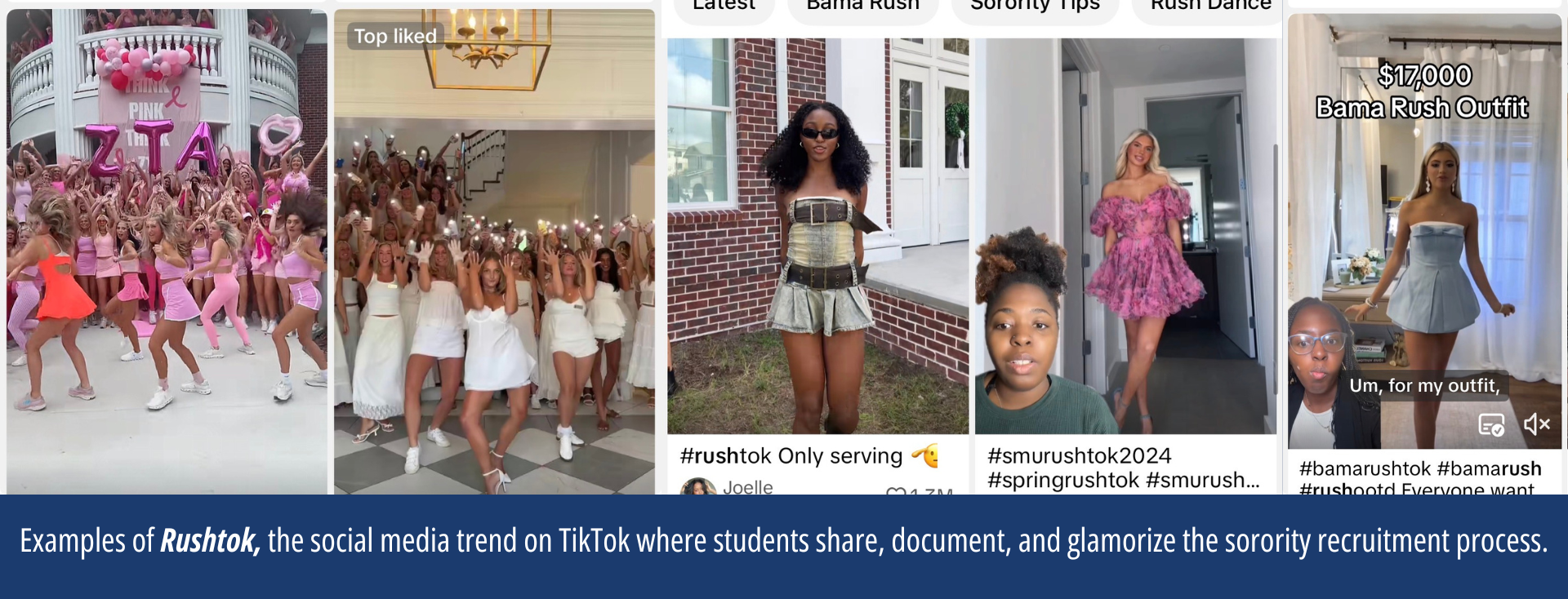
Rushtok is a TikTok subculture where college students — especially at large Southern universities — share their journey through sorority recruitment. Thousands of videos share curated outfits, expensive luxury hauls, beauty routines, branded aesthetics, and “day in the life” recruitment content that signal what it takes to earn a coveted spot in a popular sorority.
Social media attention has turned sorority life into a major marketing machine. Companies like Princess Polly have launched dedicated rush collections. Sorority chapters and members have partnered with or been paid to feature fashion brands like Poppi, Gymshark, and Altar’d State.
Private rush consultants charge thousands of dollars to help package young women for sorority membership through resume reviews, practice conversations, and wardrobe consultations.
The result is a very specific visual standard for acceptance.
The psychological impacts of social media
Social media isn’t just about entertainment for young people. It also shapes their environment.
Eight in ten young adults ages 18 to 29 say they use Instagram, and about half of them say they visit TikTok at least once a day, according to the Pew Research Center.
For women going through rush, the pressure comes not only from having the right clothes. It can also mean sounding polished, being effortlessly likable, knowing the right slang, appearing confident but not too confident, interesting but not controversial, authentic but still curated.
These implicit pressures can cause psychological harm, financial strain, insecurity, and emotional stress before a student ever joins a group.
Still, there is growing interest in sororities. According to the National Panhellenic Conference, which represents 26 national and international sororities, undergraduate membership grew by 5% in 2024–25 compared to the year before, the second consecutive year of growth.
A focus on fun over values?
“When students are consuming this content [Rushtok], they may be encouraged to focus on the fun, visual aspects of recruitment without necessarily seeing what an organization prioritizes or whether its values align with their own,” said Arielle Harris, assistant director of chapter services for fraternity and sorority life at the University of South Carolina.
Harris noted that RushTok often highlights the excitement, aesthetics, and social experience of sorority recruitment in ways that naturally capture attention and generate interest among prospective members. However, she emphasized that these videos do not always provide insight into an organization’s deeper values, expectations, or culture.
“When students are consuming this content, they may be encouraged to focus on the fun, visual aspects of recruitment without necessarily seeing what an organization prioritizes or whether its values align with their own,” Harris said.
The norms and social dynamics reflected in recruitment content can offer prospective members important clues about what a group emphasizes. For students considering recruitment, evaluating values, culture, and group dynamics can be an important part of protecting themselves from unhealthy or potentially harmful experiences.
Learn about the signs of healthy and unhealthy groups from StopHazing’s 10 Signs training here.
Recognizing harmful group dynamics
Young women joining sororities are more likely to encounter psychological hazing than physical hazing.

“Too often, hazing is dismissed as harmless jokes or 'tradition.' This continues to minimize the potential harm and lasting impacts it has on young people," said Meredith Stewart, operations manager at StopHazing.org.
Hazing hides behind phrases like “loyalty” or “earning your place,” but healthy groups do not rely on intimidation, exclusion, manipulation, or pressure to conform.
Hazing "is directly in conflict with what sororities and their leaders say they stand for and represent,” Stewart said.
Experts say you should pay attention to how members treat one another and how leaders respond to concerns.
Look for signals about how the group operates, such as transparency, encouragement, accountability, and genuine inclusion. Be vigilant for red flags like silence and secrecy, power imbalances, or exclusion.
“Healthy belonging is building a space of comfortability, but also being able to voice how you feel without feeling ostracized afterward,” Harris shared..jpg?width=903&height=715&name=StopHazing_SpectrumHazing_June2023%20(1).jpg)
What healthy belonging can look like
A recent sorority crossing ceremony I attended at a Southern university reinforced what healthy belonging can look like.
The crossing ceremony is the formal initiation ritual where new sorority members are welcomed as active members. It represents the end of the new membership process and the transition to full membership.
After crossing, new members are often introduced to the public through a "probate" or "coming out show," which features dance performances, calls, and stepping or saluting.
I witnessed a group supported not only by their peers in Greek Life, but a robust and encouraging audience of professors, campus professionals, and other students.
The event happened outside in a high-traffic area of campus for all to see. The participants showed creativity and originality, and performed dances and routines unique to their personality and ability while introducing themselves.
It was a refreshing display of trust and group bonding that demonstrated what values-based leadership can do for new recruits.
Think about your “why” before joining a group
In a culture where recruitment can feel centered on appearances, popularity, and being chosen, Taylor, an undergraduate student and sorority leader, believes students should be asking a different question.
“What kind of community am I joining, and what kind of person do I want to be inside of it?”
“A big reason why I wanted to be a member of my sorority in the first place … is the idea of servant leadership,” Taylor shared. “The heart of any leader of women should always be that you have a mindset for serving others and for helping others be their best.”
Taylor asked that we not use her last name to avoid identifying her sorority.
That philosophy shaped how she approached leadership within her chapter and how she welcomed new members. To her, leadership is about humility, responsibility, and helping others grow.
“There’s no way that you can stand up in front of a group, call yourself a leader, if you are not willing to do any and everything to help the group of people better themselves,” Taylor said.
For students considering recruitment, Taylor encourages them to think deeply about their why before joining any organization.
“When things get hard, I always come back to my why,” she said. “I want to be a part of this organization because serving the community means something to me … Serving the community with people that have those [same] values means something to me, too.”
What real sisterhood should feel like
Taylor emphasizes that recruitment is not only about whether you fit the organization but also whether the organization fits you.
She also encourages students to look for green flags that organizations center the signs of healthy belonging, such as being visible in service activities, active on campus, and led by members who show character beyond formal events.
Fraternities and sororities have the access and opportunity to build students up rather than cause harm.
For Taylor, sorority membership has meant friendship, mentorship, travel, leadership training, and opportunities she cannot imagine missing. But the lesson she returns to most is simple: Community works both ways.
Healthy belonging is not a place where you have to perform to be accepted, but a place where people grow because they are invested in one another.
If joining a group requires you to change who you are, overspend to keep up, stay quiet to be accepted, or perform a version of yourself that isn’t authentic, it’s worth asking: Is this space truly built for connection?
Check out more resources for values-based leadership and development here.