

- Hazing incidents
- Hazing laws
- 8 mins
Harassment, humiliation, paddling: 129 hazing incidents reported across campuses in the South since 2025
Editor’s note: This is part of our series of regional snapshots examining how campuses are responding to the new federal law requiring hazing transparency. Read the rest of our series on college hazing in Western states, New England, the Mountain West, and the Mid-Atlantic.

Last fall, a group of pledges at Georgia College & State University decided to join their campus chapter of Kappa Alpha Order, one of the nation’s oldest fraternities.
The cost to join? Enduring weeks of brutality.
The pledges were:
- Threatened, humiliated, isolated, harassed, and forced to chug liquids and repeatedly deep-clean members’ private residences along with the chapter house.
- Required to run errands and provide transportation for members and respond immediately to frequent, demanding text messages, day and night.
- Told to send humiliating messages to strangers or pose for photos or videos in embarrassing or compromising positions.
- Forced to stay at chapter-affiliated properties for extended periods and seek permission to leave.
- Required to perform the “bread test”: Wipe a piece of bread across surfaces they had cleaned and then eat it to demonstrate cleanliness.
Pledges who reported the behavior or left the organization received repeated, harassing phone calls and messages from multiple numbers.
After a campus investigation, 22 students were charged with a total of 45 hazing-related violations.
Yet Kappa Alpha Order itself received minimal punishment. The university suspended the chapter until next summer. The fraternity can apply to be reinstated for the 2027-28 school year.
Fewer than half of Southern schools disclose hazing incidents
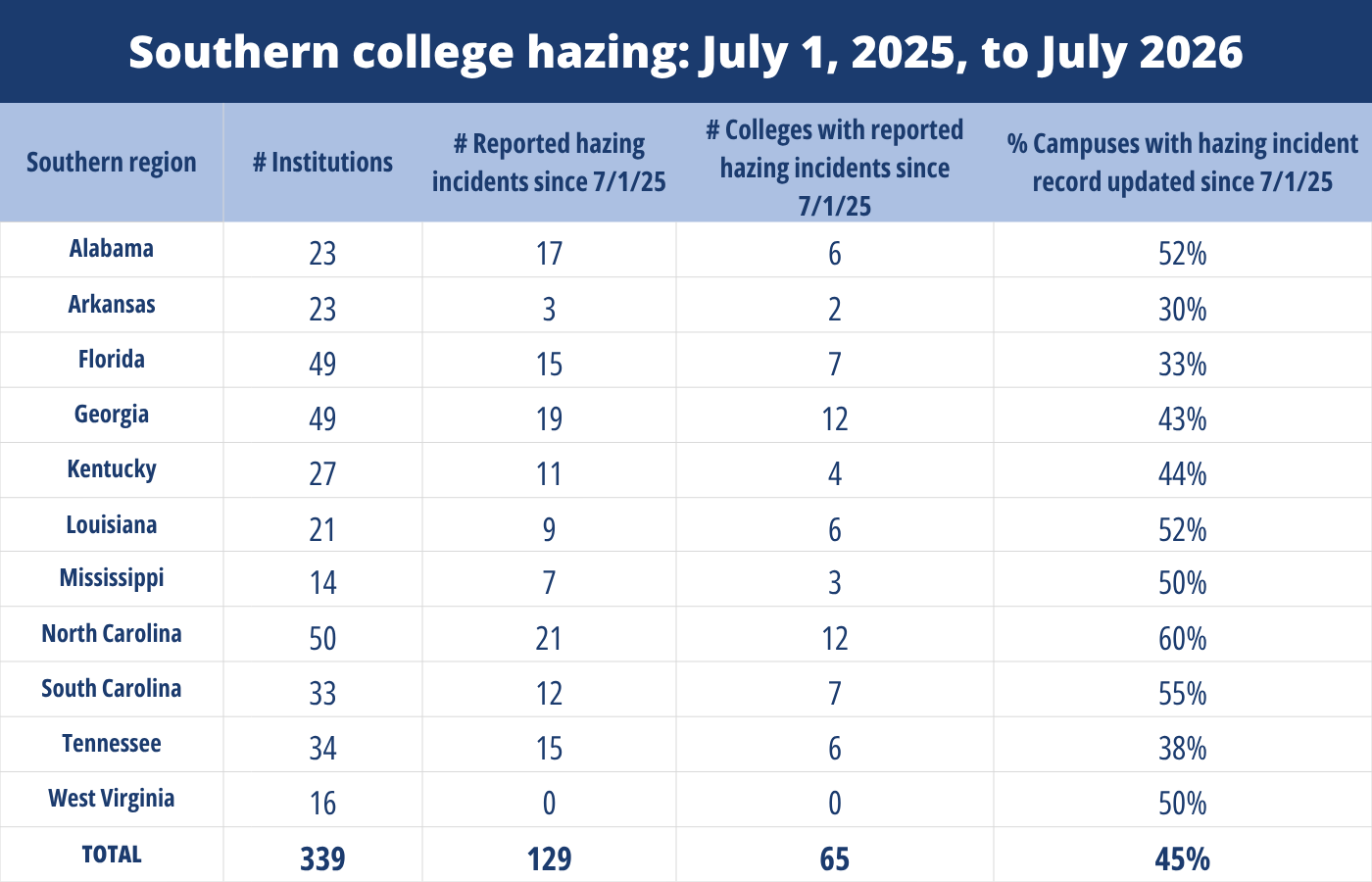
That incident was just one of 129 hazing incidents reported across college campuses in 11 Southern states since July 2025.
HazingInfo reviewed the Campus Hazing Transparency Reports of 339 college campuses across the South to count the number of reported hazing incidents.
We found 65 colleges and universities reported hazing incidents in the past year.
Also of note: Just 45% of campuses in the South have published an updated hazing incident record as required by a new federal law.
New federal law requires hazing transparency
That law, the Stop Campus Hazing Act, requires every college and university to publish hazing incidents twice a year in a Campus Hazing Transparency Report available on its website. As part of the law, each campus had to start documenting hazing-related violations of its code of conduct on July 1, 2025.
The law does not technically mandate a hazing transparency report until there has been a formal finding of a hazing violation. But hazing experts say every school should issue a report whether they have a hazing incident or not for full transparency.
States included in HazingInfo’s review are Alabama, Arkansas, Florida, Georgia, Kentucky, Louisiana, Mississippi, North Carolina, South Carolina, Tennessee, and West Virginia.
Source: HazingInfo.org
What hazing looks like in North Carolina and Arkansas
North Carolina campuses reported 21 hazing incidents in the past year, the most in the region. It also had the largest number of schools publicly sharing that information, with 58% of campuses publishing a Campus Hazing Transparency Report.
Compare that to Arkansas, which reported just three hazing incidents. But only 30% of its campuses publish a hazing report, the lowest in the region.
In North Carolina, Elon University, High Point University, and North Carolina State University at Raleigh each reported three hazing incidents.
At North Carolina State, the Alpha Kappa Psi business fraternity was sanctioned for making its pledges listen to distressing sounds for hours. Beta Upsilon Chi, a Christian fraternity, required new members to carry around backpacks with heavy weights and participate in a cross-country scavenger hunt. Theta Chi fraternity required pledges to run errands, clean the chapter house, and participate in lineups that included calisthenics.
University of North Carolina at Charlotte reported two hazing incidents but failed to provide a basic description of the incidents as required by law.
Winston-Salem State University also reported two hazing incidents, including one by Phi Mu Alpha Sinfonia, a music fraternity, in which students were paddled and left bruised, disoriented, and exhausted.
Hazing in Georgia
Georgia colleges and universities reported 19 hazing incidents, with 43% of campuses publishing a hazing report. That included three incidents at Emory University involving Alpha Tau Omega and Kappa Sigma fraternities and Alpha Kappa Psi business fraternity.
At Fort Valley State University, three members of the school’s marching band were taken to an off-campus residence for initiation rituals that included paddling and exercises.
Hazing in Alabama
 Schools in Alabama reported 17 incidents across six different campuses statewide. Just over half of Alabama campuses publish a Campus Hazing Transparency Report.
Auburn University and the University of Alabama reported six hazing incidents each in the past year. All of those hazing incidents involved fraternities. At the University of Alabama in Huntsville, an Alpha Tau Omega pledge reported that his entire pledge class was subjected to emotional and mental stress from hazing during the pledge process. He said other pledges were too afraid to report because they felt threatened by the fraternity’s new member educator.
Hazing in Florida and Tennessee
Campuses in Florida and Tennessee each reported 15 hazing incidents in the past year. But only 38% of schools in Tennessee published a Campus Hazing Transparency Report. In Florida, 52% of campuses reported.
At first glance, Florida Atlantic University appears to have zero hazing incidents to report. But dig a little deeper on the school’s website, and there are five hazing reports labeled “mutual agreements,” the university's approach to resolving hazing allegations through an “alternative resolution process.” Four fraternities and one sorority were disciplined for “behaviors meeting the definition of hazing.”
University of Central Florida reported three fraternity hazing incidents, including one at Tau Kappa Epsilon in which new members were told to wear “Where’s Waldo?” costumes on campus and run errands and complete cleaning tasks for older members.
In Tennessee, six hazing incidents were reported at the University of Tennessee-Knoxville. The hazing included calisthenics, verbal punishment, servitude, embarrassing tasks, and emotional hazing. Incoming members at Theta Chi fraternity were told to complete a puzzle and sort sprinkles by color — in the dark.
Vanderbilt University reported four hazing incidents, including an incident on its rowing team. Bethel University, a small private school, reported one hazing incident at Zeta Nu Theta sorority, where new members were blindfolded and told to take part in “trust exercises,” including walking barefoot across what they believed to be broken glass.
Hazing in South Carolina, Kentucky, Louisiana, Mississippi, and West Virginia
 South Carolina campuses reported 12 hazing incidents, with 55% of schools reporting. Clemson University reported four incidents, the highest in the state. In one case, Delta Chi members required pledge driving, personal labor, and line-ups of new members and even created a script for members that had the “potential to disrupt” the university’s hazing investigation. While that incident was listed on Clemson’s Campus Hazing Transparency Report earlier this summer and reported by local media, it has since been removed from the report without explanation.
- Kentucky campuses reported 11 incidents, with 44% of schools publishing a Campus Hazing Transparency Report. A men’s cross-country team, a Christian fellowship group, and numerous fraternities were disciplined for hazing across the state. The University of Kentucky had the most reported hazing incidents with four.
- Louisiana colleges and universities reported nine hazing incidents, with 52% of campuses reporting. Tulane University reported the highest number of incidents, with three, but did not provide details as the law requires. Louisiana State University reported zero hazing incidents. Not mentioned: Two serious campus hazing incidents at LSU last fall involving Tau Kappa Epsilon and Kappa Sigma fraternities that resulted in police investigations and media coverage.
- Mississippi schools reported seven hazing incidents, with 50% of schools publishing hazing reports. The University of Mississippi reported four incidents, including one at Phi Kappa Psi fraternity where police saw a group of about 30 people inside a fraternity house who were made to stand at attention and repeatedly perform exercises.
- West Virginia schools reported they had no hazing incidents in the past year, with half of campuses reporting.
Experts note that higher numbers of reported hazing cases don’t necessarily mean that hazing is a bigger problem at those campuses.
"Increases in reporting are often a sign of progress—not necessarily increases in prevalence," said Dr. Elizabeth Allan of the research organization StopHazing.org. "While hazing reports warrant attention and investigation, they can also reflect an institution’s commitment to prevention, transparency, and accountability."
Read the rest of our series of regional snapshots investigating college hazing in Western states, New England, the Mountain West, and the Mid-Atlantic.