
Ohio is the only state with more than 70% of college campuses publishing their hazing incidents, policies, and reporting information

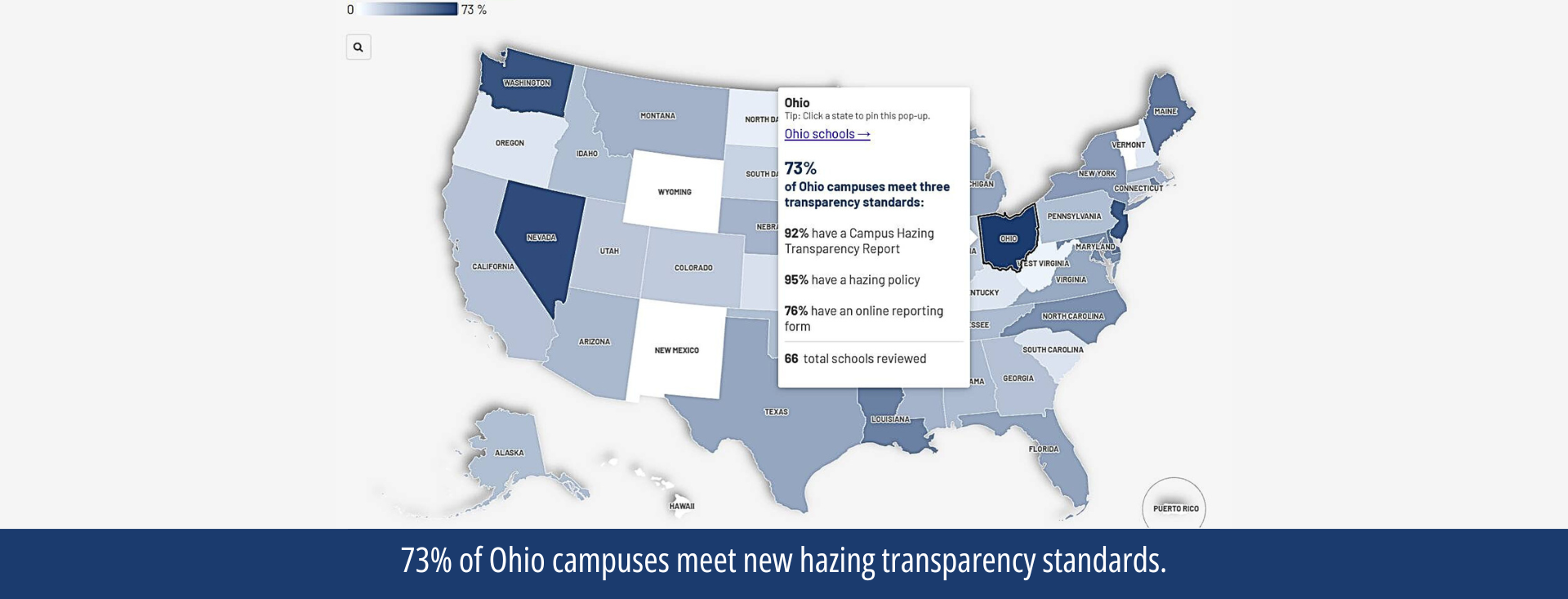
Ohio is the only state where more than 70% of colleges and universities meet new hazing transparency standards, according to HazingInfo.org's state-by-state review.
About 73% of Ohio’s 66 colleges and universities now post three key pieces of information on their websites in response to the nation’s first federal law against hazing: a record of hazing incidents, a hazing policy, and an online form for reporting hazing.
Colleges and universities in 49 other states, Washington, DC, and Puerto Rico are significantly behind in complying with the new Stop Campus Hazing Act.
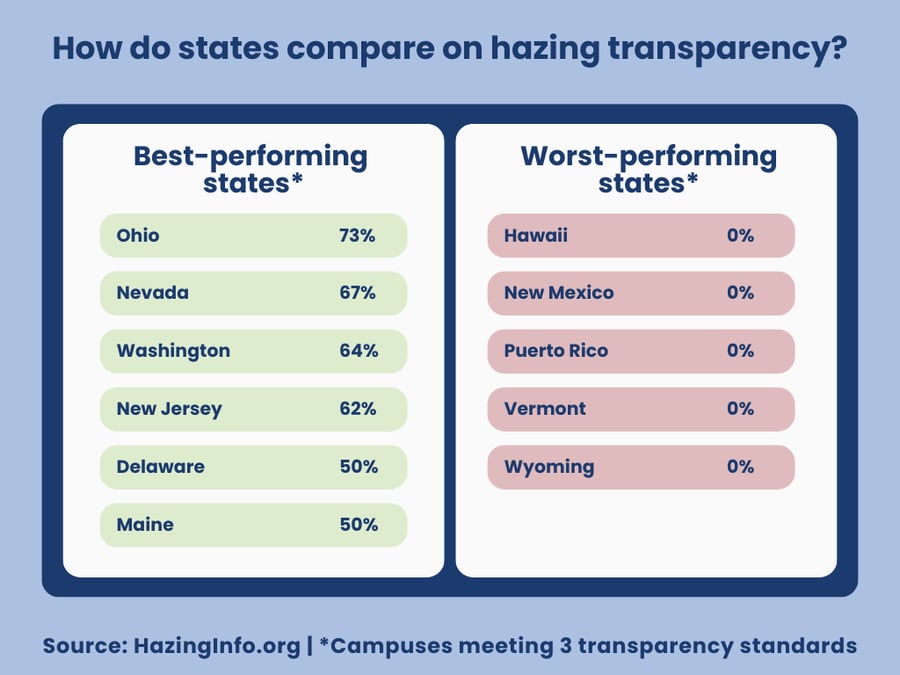
At the bottom: Hawaii, New Mexico, Puerto Rico, Vermont, and Wyoming, where no colleges or universities provide all of the required information.
Less than half of campuses in 44 states fully comply with new law
It’s been more than two months since the Stop Campus Hazing Act was fully in effect.
The 2024 law requires all colleges and universities — public and private — to publicly disclose hazing incidents or face steep financial penalties. The deadline for posting that information was Dec. 23, 2025.
The law also mandates that campuses publish a hazing policy and a method for reporting hazing.
HazingInfo found just six states with more than half of their campuses meeting transparency standards: Ohio (73%), Nevada (67%), Washington state (64%), New Jersey (62%), Delaware (50%), and Maine (50%).
Ohio, Washington, and New Jersey all have state hazing transparency laws that were on the books before the federal law passed, and that may have given them a head start in meeting the new federal requirements.
How HazingInfo evaluates hazing transparency
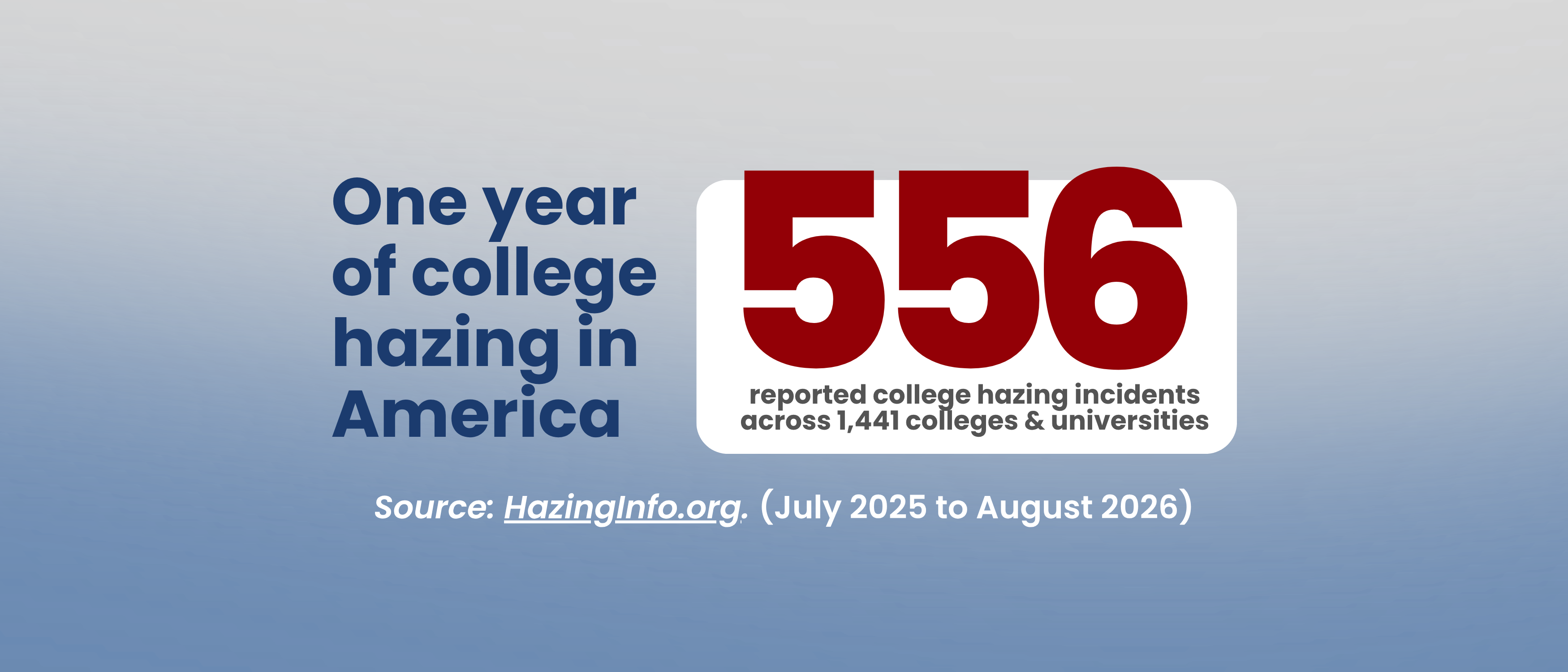
 HazingInfo tracks hazing transparency at nearly 1,500 colleges and universities across the US, monitoring their progress toward full disclosure about hazing on their campuses. You can search your campus here.
Our new interactive map shows how states compare in meeting the new transparency measures. The map was developed by Lana Burke, master’s student in the University of Washington Information School.
HazingInfo also just published a state-by-state hazing transparency dashboard. It shows the number of  higher education institutions in each state meeting each of the three transparency standards. The dashboard was created by HazingInfo student assistants Ryan Cho and Beliz Ozhan, both undergraduate students in the UW Information School.
HazingInfo uses a color-coded checkmark system to show which campuses are actively working to be transparent, and which are not.
Each school’s listing on HazingInfo includes links to the following when available:
- A hazing incident record (called a Campus Hazing Transparency Report).
- A hazing prevention policy.
- An online hazing reporting form.
- An email address to report hazing or get information about hazing.
- A dedicated hazing hotline phone number where hazing can be reported.
Going above and beyond to keep students safe
In some cases, HazingInfo’s evaluation standards are higher than what is required by law.
For example, the law requires campuses to share how to report hazing incidents, but it provides no details about what the reporting process should be.
HazingInfo lists all available hazing reporting methods for each school, but we specifically evaluate schools on whether they have an online form for hazing reporting. We believe that is the simplest, most accessible way to report hazing for most students, families, and community members.
Federal law does not require a campus to issue a Campus Hazing Transparency Report unless it had a formal finding of a hazing violation.
But HazingInfo believes students and families should know whether or not their campus has had a finding of hazing, so they can see that their school is aware of and responsive to the Stop Campus Hazing Act.
Many campuses simply post a sentence that reads: "There were no findings of hazing behavior during this time period."
That statement meets HazingInfo's standards. And it signals to students and families that the campus is meeting both the letter and spirit of the law.
How seriously does your campus take hazing? Search our Campus Hazing Database.