
- Hazing laws
- 6 mins
Hazing is now a reportable crime under federal law. Schools that don't comply may face hefty fines

Colleges and universities now face the prospect of federal investigations, steep financial penalties, and reputational damage for not coming clean about campus hazing incidents.
Those are the teeth behind a new law called the Stop Campus Hazing Act that forces all public and private higher education institutions to put hazing information in public view.
It’s the first time there have been mandatory financial consequences for colleges and universities that do not disclose hazing incidents.
And that will likely lead to greater transparency about hazing, giving students and parents a better sense of which campuses address hazing as a serious health and safety risk, experts say.
"Sometimes compliance can be the motivation, particularly when there are fines attached,” said Abby Boyer, policy and prevention specialist for the research organization StopHazing.org.
Schools could face fines of $71,545 per violation
The Stop Campus Hazing Act, passed in 2024, will be enforced under the federal Jeanne Clery Campus Safety Act.
The 35-year-old consumer protection law requires colleges and universities that receive federal funding to publicly disclose information about crimes on and around campus, including homicides, sexual assaults, robberies — and now, hazing.
Fines for Clery Act violations are currently $71,545 per violation. Those fines can add up fast, said S. Daniel Carter, president of the campus security consultancy SAFE Campuses.
.png?width=245&height=214&name=Abby%20Boyer%2c%20StopHazing%20(2).png) Between 2000 and 2023, 92 colleges and universities were fined more than $20 million by the US Department of Education for violations related to Clery Act reporting, he said.
Between 2000 and 2023, 92 colleges and universities were fined more than $20 million by the US Department of Education for violations related to Clery Act reporting, he said.
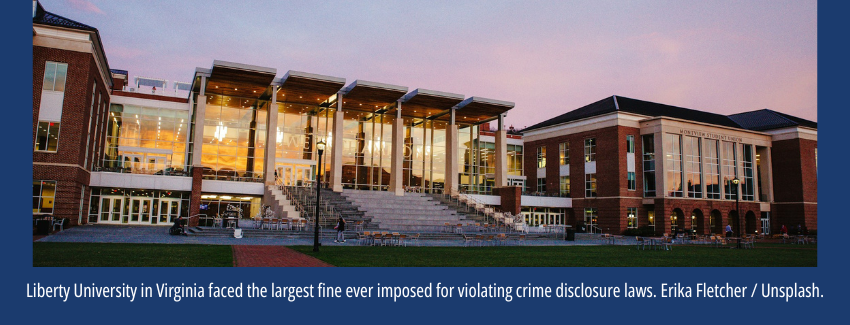
In 2024, Liberty University, a large, Christian university in Lynchburg, VA, was fined $14 million for ongoing violations of the Clery Act — the largest fine ever imposed under the law. Federal authorities documented violations that included discouraging students from reporting crimes, inadequate response to sexual violence incidents, and not maintaining an accurate crime log.
Even smaller fines can be significant for the small and mid-sized campuses Carter advises. While larger schools may see financial penalties as “the cost of doing business,” he said, the fines are intimidating for smaller schools. Institutions can also face reputational damage that could affect student enrollment, increased public scrutiny, and the potential loss of federal student aid funding.
How Clery Act enforcement works
Enforcement of the Clery Act falls to a small group of about a dozen people at the US Education Department’s Federal Student Aid office.
The team reviewed 186 media reports and complaints for possible Clery Act violations in fiscal year 2024, according to the office’s annual report. That included 41 complaints submitted by the public and 145 campus crime media reports. All 41 public complaints and about 16% of the media reports led to follow-up investigations.
Many colleges and universities respond by fixing identified problems before the process moves to the next level, a comprehensive program review, Carter said. “It’s not all about fines. If they can accomplish corrective action without a fine, they will.”
Fines for hazing-related violations could add up
Campuses can be fined for a wide range of violations, including omitting or misrepresenting required information in their Clery reports. The more serious the offense, the higher the fine, Carter said.
Highest Clery Act fines, 2000 to 2024
%20(1).png?width=862&height=833&name=Top%205%20Clery%20Act%20fines%20(1)%20(1).png)
With hazing now a reportable crime, Carter said fines could be levied for violations such as:
- Not publishing a Campus Hazing Transparency Report or not updating it as required.
- Failing to report a hazing incident or misrepresenting the nature of the incident.
- Failing to have a hazing policy or to provide a way for people to report hazing.
- Misstating or not offering a hazing prevention and education program.
Each separate violation can result in a fine, Carter said. Fines have gotten progressively more significant over the 35 years since the Clery Act was passed.
Campuses await guidance from Education Department
Exactly how will federal authorities approach enforcement of hazing reporting requirements under the Clery Act? That’s still something of a mystery.
The Education Department hasn’t yet issued formal guidance on how it will respond to Stop Campus Hazing Act enforcement.
Many campuses have been awaiting that communication — commonly called a “Dear Colleague letter” — for more than a year, said Boyer, with StopHazing.org.
In the meantime, the Education Department itself has been roiled by restructuring and budget cuts that have reduced its workforce by about half, forcing fewer people to take on more work.
Boyer believes the department’s Clery team may focus first on schools that have not posted a Campus Hazing Transparency Report or that have no hazing policy.
More than 55% of campuses nationwide missed the December 2025 deadline to post their hazing incident reports, according to a recent review by HazingInfo.org. And nearly 30% of colleges and universities have no published hazing policy.
Some campuses embrace both the letter and spirit of the law
It’s likely the Education Department will give campuses several years to come into compliance and work with them on the new reporting requirements before imposing fines, Carter said.
It took a decade for a Clery Act fine to be imposed after the 1990 passage of the law, Carter said. “Schools are given time to get it right. They are trying. Not all, certainly, but most are.”
Boyer said her campus safety colleagues are hearing from campuses that are “looking for the training and resources to do this work well.”
And many campus professionals are encouraged to be getting more attention and resources “to deal with a problem that’s been ignored for years,” Carter said. "Now, finally, someone is taking them seriously … it’s not just a question of what you have to do. It’s embracing the spirit of the law.”
Some schools see it as a “checkbox burden,” he said, and it is a significant undertaking to meet all of the law's requirements.
But Carter urges his clients to think more broadly, using Clery compliance as a centralized framework for campus safety. When it’s done right, it’s about people working together and engaging the whole community, he said, so that “everything you do is about making your campus safer.”
How students and parents can access hazing information
Boyer encourages students and parents to actively seek information they are entitled to under the Stop Campus Hazing Act.
Check HazingInfo.org’s campus hazing database for information about each school’s published hazing incident report, prevention policy, and methods for reporting hazing.
If the school hasn’t published that information, students and parents can ask their campus Clery coordinator or student conduct office how to find it, Boyer said. They can also request that the campus public safety office share their crime log reports for hazing.
That information can be shared with peers and student organizations to raise awareness of hazing transparency requirements, she said.
“Student voices are so powerful because they are the constituents,” Boyer said. The simple act of asking about hazing incidents and policies can alert campus administrators that their community expects to see that information.
Under the new law, campuses are not technically required to publish a Campus Hazing Transparency Report unless they had an incident that resulted in a finding of hazing.
But Boyer and Carter both urge campuses to publish a report even when there hasn’t been a finding of hazing.
“Even that statement — we have no hazing findings — that is transparency,” Boyer said.
How seriously does your campus take hazing? Search our Campus Hazing Database.