

- Hazing incidents
- Hazing laws
- 5 mins
HazingInfo’s review of 1,441 US colleges and universities finds widespread hazing as new federal law reveals transparency gaps
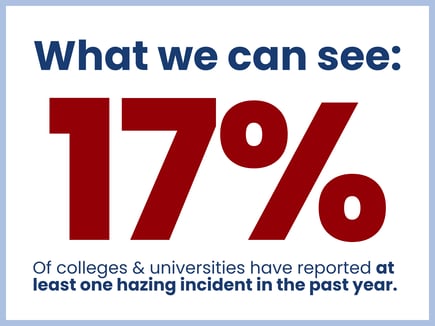
About 1 in 6 US colleges and universities reported at least one hazing incident in the past year, a new analysis by HazingInfo finds.
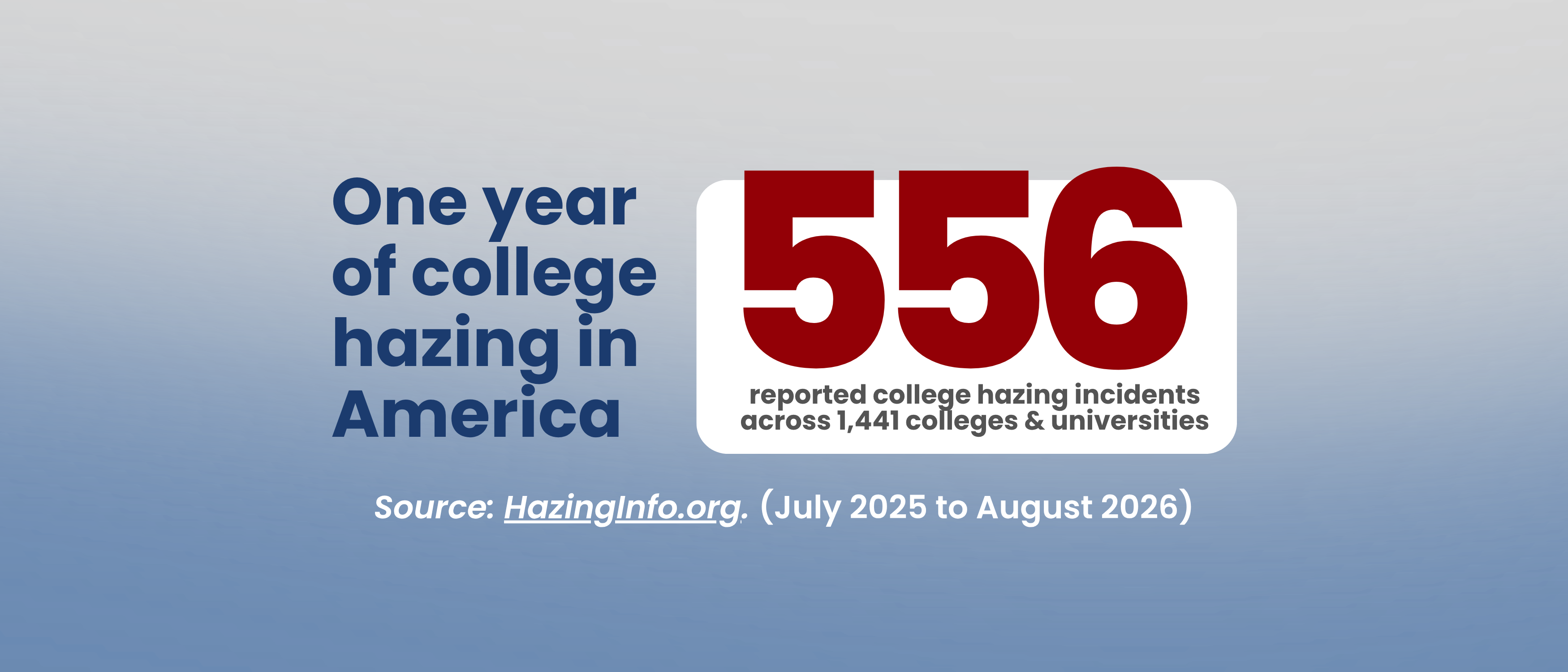
Campuses disclosed at least 556 hazing incidents since July 1, 2025, giving America its first look at the scale and nature of college hazing through new national transparency data.
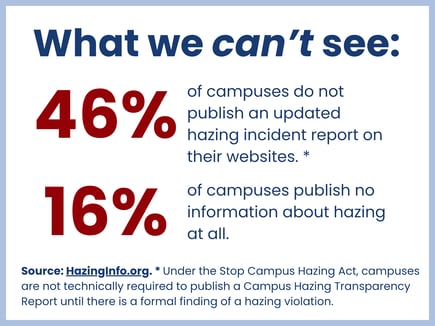
But the picture remains incomplete. HazingInfo’s review shows only 54% of colleges and universities have published hazing transparency reports since a new federal law went into effect last year requiring greater transparency about campus hazing.
“Students and families can now see there are hundreds of hazing incidents documented on campuses each year,” said Jolayne Houtz, HazingInfo's founder. “That likely means thousands of hazing victims.”
“Hazing is not an isolated issue for a handful of fraternities or campuses. It is a public health crisis and a national disgrace,” Houtz said.
What hazing looks like
 Students were beaten, humiliated, harassed, isolated, deprived of sleep, coerced into excessive drinking, and punished with required cleaning duties and physical exercise to the point of exhaustion.
Just one example: Last fall, six fraternities at the University of Alabama subjected their new members to line-ups, forced exercise, personal servitude, forced consumption of alcohol, and physical abuse that resulted in injury.
Two deaths from hazing were reported in the past year: Colin Martinez at Northern Arizona University and Savanna Jones at Wilberforce University in Ohio.
Colleges and universities were required to start documenting hazing incidents on July 1, 2025, under the federal Stop Campus Hazing Act.
Schools had to publish their first Campus Hazing Transparency Reports by Dec. 23, 2025. Those reports must be updated twice a year under federal law.
What we know about hazing — and what we still don’t
 HazingInfo reviewed the websites of 1,441 colleges and universities in all 50 states and Washington, DC, this summer. That’s the number of campuses with bachelor's degree programs and on-campus housing.
We found:
- 780 campuses (54%) have an updated Campus Hazing Transparency Report.
- At least 556 hazing incidents were reported involving fraternities and sororities, sports teams, marching bands, performing arts groups, and other student organizations.
- Those incidents were reported by 253 campuses (about 17% of colleges and universities).
- Some schools remain hazing information deserts. About 1 in 6 campuses (16%) share no hazing information at all on their websites — no policy, no incident report, no way to report hazing online. That transparency gap means students and parents are flying blind.
The 556 reported hazing incidents are likely just a fraction of the actual number of hazing incidents on college campuses. That’s because schools only need to disclose a hazing incident when it results in a formal finding that a student organization violated the institution’s standards of conduct related to hazing.
Hazing that is reported but not investigated or that can’t be substantiated is not included in a Campus Hazing Transparency Report, nor are incidents that are still under investigation. The investigation process can take months to complete.
And campuses are not technically required to publish a Campus Hazing Transparency Report until there is a formal finding of a hazing violation, according to federal law.
Zero hazing incidents may not mean hazing-free
States that reported the highest number of hazing incidents are among the largest states, including California (58 incidents on 22 campuses), Texas (44 incidents on 17 campuses), and New York (39 incidents on 20 campuses).
Campuses with the highest number of reported hazing incidents in the past year include large schools like the University of Michigan-Ann Arbor (22), James Madison University (14), Pennsylvania State University and University of Washington (each with 12), and University of California, Davis (9).
But there’s an important caveat: Colleges that report more hazing incidents aren’t necessarily colleges where more hazing occurs.
The numbers could instead indicate a stronger reporting culture on campus, better investigations, more rigorous enforcement, or greater transparency.
Conversely, a campus reporting zero incidents isn't necessarily hazing-free.
Families could interpret zero findings of hazing incidents in several ways: no hazing occurred; hazing occurred but wasn’t reported; hazing occurred but wasn't substantiated by an investigation; or hazing violations exist but the school did not disclose them.
The state of hazing on America’s college campuses
The national picture of hazing remains incomplete for now. The public disclosure of hundreds of documented hazing incidents should not necessarily be interpreted as evidence that hazing is increasing or decreasing.
Rather, it may mean that, for the first time, the public is beginning to see the scale of a problem that has long been hidden.
A different look at hazing data will be available later this fall when campuses must report hazing statistics in their Annual Security Reports required under the federal Jeanne Clery Campus Safety Act. Those statistics will include any reported hazing incident that meets the Clery Act's definition of hazing, whether or not there was an investigation or formal finding.
Learn more about how HazingInfo evaluates campus hazing transparency.