

- Hazing incidents
- Hazing laws
- 6 mins
A first look at new federally required hazing data shows large colleges and universities are mostly complying with the law — but many don’t make it easy to report hazing
Scroll down for our list of 150-plus large campuses ↓
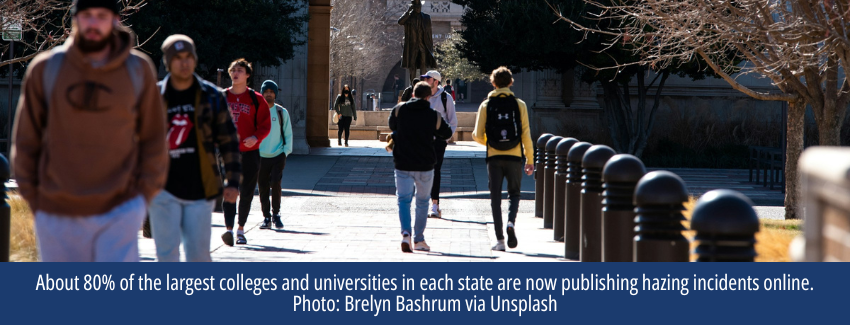
About 80% of the largest colleges and universities in each state are now publishing hazing incidents on their websites, many for the first time.
That’s because of the Stop Campus Hazing Act, a new federal law requiring every US higher education institution to publicly disclose hazing incidents. That requirement went into effect December 23, 2025.
HazingInfo examined the websites of the largest campuses in each state, more than 150 schools in all, between December 24 and January 8. We wanted to see how colleges and universities are complying with the law. Here’s what we found:
- Hazing incident reports: 21% of large campuses have not published the required Campus Hazing Transparency Report. Among the schools not in compliance: Boston University, Brigham Young University, Temple University, University of Massachusetts-Amherst, University of Minnesota-Twin Cities, University of New Mexico, and Yale University.
- Hazing policies: 5% of large schools do not have a hazing policy that clearly states how hazing cases are investigated, another new requirement of the law. That includes Boise State University, Portland State University, and University of Georgia, which define hazing but do not provide information on adjudication or consequences.
- Hazing reporting: All schools are now required to provide information on how to make a report of hazing. While nearly all large campuses have either an online hazing reporting form, a hazing hotline, or an email contact to report hazing, only 40% of those schools provide all three reporting mechanisms.
Many campuses still aren’t fully transparent about hazing
HazingInfo’s team of researchers and fact-checkers spent more than two weeks digging into the websites of large schools in each state — 157 campuses in all — to understand how they are responding to the new law.
Our findings are a snapshot of how schools with some of the largest undergraduate student populations are complying with the law’s hazing transparency requirements.
Just 32% of the large schools HazingInfo investigated have all five components of transparency that we look for when evaluating whether schools are being open about hazing on their campuses:
- A hazing transparency report with information about organizations sanctioned for hazing, including a date when the report was last updated, even if there are no incidents to report.
- A campus hazing policy that defines hazing and describes related disciplinary procedures and consequences.
- An online hazing reporting form clearly labeled for hazing. Many campuses only have “public incident” or “general conduct” reporting forms that don’t name hazing as one of the issues that can be reported. We found 27% of large schools we examined do not provide this.
- A non-emergency hazing hotline phone number where anyone can report hazing. We found 31% of large schools in each state do not offer this as a reporting mechanism.
- An email address publicly identified as the place to go to report or ask questions about hazing. HazingInfo found 33% of large schools do not have such an email address.
One large school — the private, for-profit Grand Canyon University in Phoenix, Arizona — had none of the required information about hazing on its website. The university is mostly online, but also offers an on-campus experience.
Hazing data still is not easy to find
Most of the large schools HazingInfo studied have scattered their hazing information across multiple webpages, from policy catalogs to student conduct pages to student affairs, fraternity and sorority life, and campus police websites.
Too often, information is deeply buried on those pages, making it difficult for students and families to find. Only a handful of large schools publish all of their hazing transparency information on a single webpage.
Learn more about how HazingInfo evaluates campus hazing transparency here.
A tipping point for hazing prevention?
While overall transparency about campus hazing still needs improvement, HazingInfo’s finding that 80% of large schools now publish their hazing incidents online offers hope that the Stop Campus Hazing Act could mark a tipping point in hazing prevention.
The first federal anti-hazing law, signed by President Joe Biden in 2024, was the result of a decade of advocacy by families of hazing victims and their supporters.


Coming soon: HazingInfo data on all US colleges and universities
HazingInfo's team continues to gather data on all 1,500 colleges and universities in our database — all public and private schools across the US that offer four-year undergraduate degree programs and have residential housing.
We will publish data for all schools later in January. Preliminary results indicate many small- and medium-sized campuses, including religiously affiliated schools, are not yet complying with the law’s hazing transparency requirements.
Our database does not include community colleges, online-only schools, or some specialized schools such as medical and law schools or theology programs.

.png)